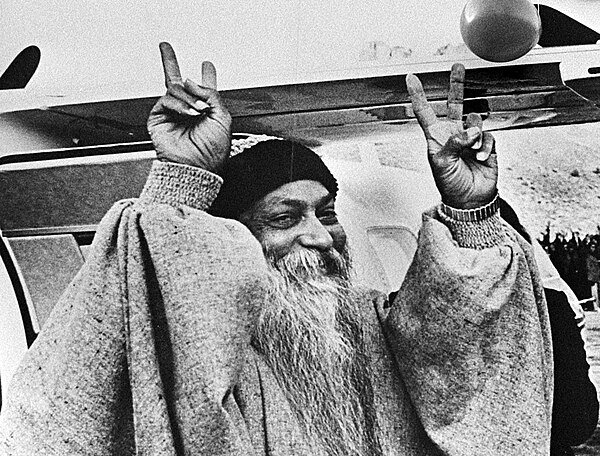

Osho (11 December 1931 – 19 January 1990), born Chandra Mohan Jain in Kuchwada, Central Provinces, British India, was a speaker, mystic, and author who became one of the most widely heard non-traditional spiritual teachers of the twentieth century.
He is often remembered under his earlier public name, Bhagwan Shree Rajneesh, and later simply as Osho. Across decades he addressed meditation, psychology, religion, and society in thousands of discourses, insisting that truth is something to be lived and tasted, not adopted as a belief.
Note. This overview is written for readers who want neutral context before opening books or talks. It summarises widely documented biography and teaching themes; for scholarly detail, follow the archival and publisher links elsewhere on this site and in standard references such as Wikipedia.
Use this page for chronology and context, then follow books, discourses, and audio & video for the work itself. Controversy is not erased below; it is placed in the same timeline as the teaching so you can read without either hagiography or sneer.
Early life and awakening
He was raised for much of his childhood by his maternal grandparents, who gave him unusual freedom and contact with nature.
He later described a formative mystical experience at age seven — a sense of dissolving into the sky — that oriented him away from conventional piety toward inner exploration. He read widely as a boy and took a keen interest in argument, public speaking, and the great contemplative traditions, long before he had any formal role as a teacher.
Scholarship and public teaching
After university he lectured in philosophy at the University of Jabalpur, where his clarity and originality were already noted. In the 1960s he stepped away from a conventional academic career and began holding meditation camps and open-air gatherings, attracting educated Indians and foreigners.
His teaching style combined humour, story, and close readings of Zen, Sufi, Taoist, Hasidic, and Hindu sources alongside modern psychotherapy and science — always with the practical aim of awareness in daily life rather than sectarian loyalty.
Communities: Pune, Oregon, and return
In 1974 an ashram formed in Pune (then Poona), which grew into an intense international centre for meditation, group processes, and daily discourse.
In 1981 the community relocated to a ranch in Oregon, USA, incorporated as the city of Rajneeshpuram — a period that drew intense media and legal attention. After Osho left the United States in 1985, he returned to Pune.
The commune gradually rebranded around his final name, Osho, and continued as a hub for meditation, publishing, and archival work until and after his death in 1990.
Teaching emphasis
He repeatedly challenged orthodox religion, nationalism, and sexual repression, which made him controversial; at the same time he advocated meditation techniques (including the dynamic methods developed around his guidance), therapeutic honesty, and a kind of religiousness without priests or fixed dogma.
His recorded talks — in Hindi and English — and the books transcribed from them remain the main way new readers encounter his work today.
This site is dedicated to organizing that written, audio & video, and practice material for people who want to explore the teachings directly, without focusing on movement politics or headlines from any single era.
Continue from here
Move from life story into the catalog and themes most readers combine with biography.
- Books hub — e-books, Hindi, translations, and shop search by category.
- Osho’s words — title index with outbound read/buy links.
- Discourses — series by figure and theme.
- Osho on Zen and Sufism — themed reading lists inside the book index.
- Quotes — short excerpts with sources.
- Photos — official sources and notes on republishing images.